Redesigning NYU Steinhardt's ECT Internship Program
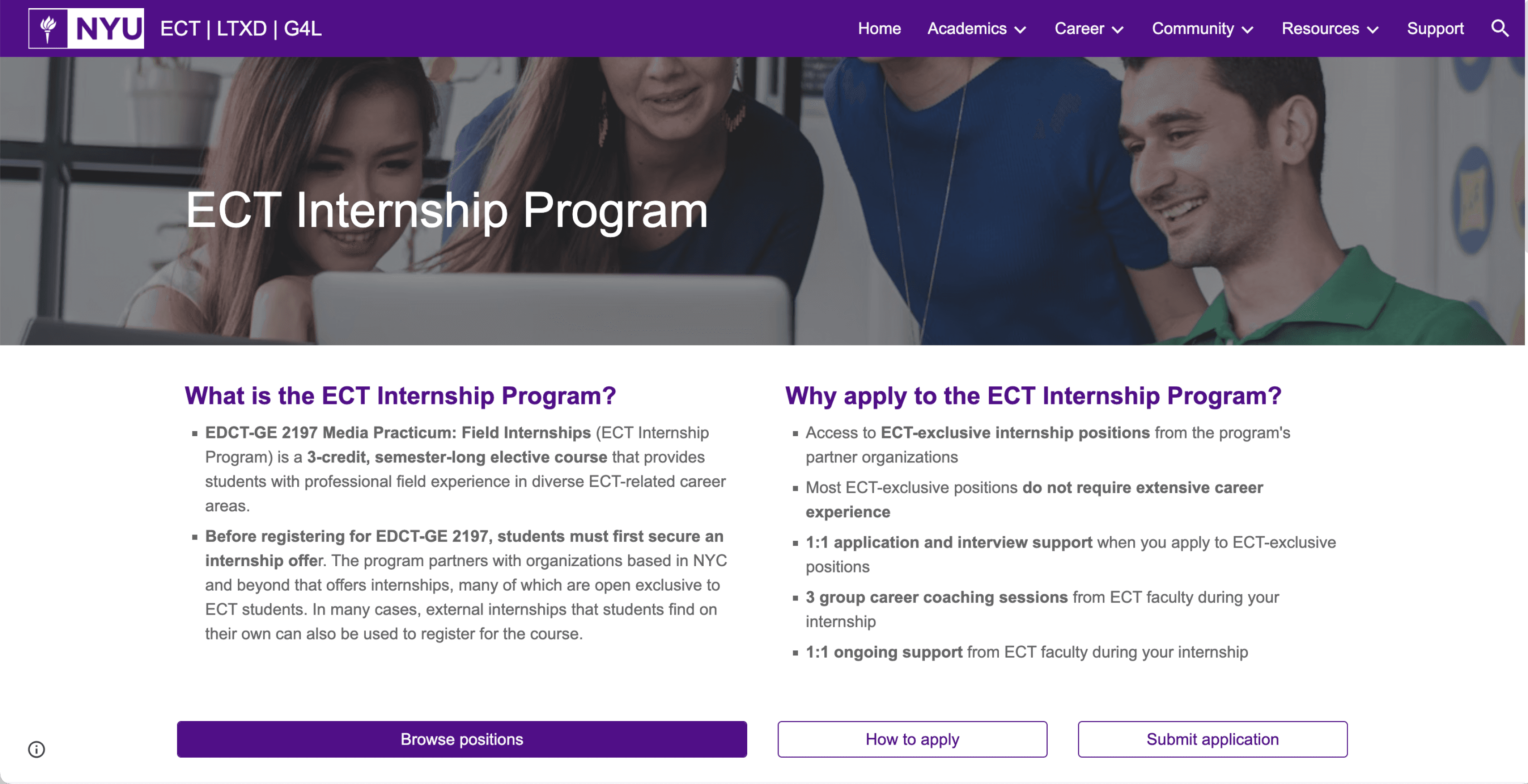
As part of my EdTech UX Studio: Design for a Client course at NYU, my partner and I modernized the ECT Internship Program’s application experience for students. Together, we redesigned the entire internship ecosystem, including how opportunities are submitted, published, and viewed by students, reducing admin workload by over 30%.
Role: Product Design Co-Lead & User Research Lead
Tools: Notion, Figma, FigJam, Google Sites & Forms
Partner: Xinhui Xu, Product Design Co-Lead & UX Writing Lead
Timeline: 12 weeks (September - December 2025)
Service Design
UX Research
Workflow Design
Information Architecture
THE CHALLENGE
How do you scale an internship program that has doubled in enrollment while running on an admin team of one?
As experiential learning continues to be crucial for design students in today’s job market, NYU Steinhardt's Educational Communication & Technology’s internship program has doubled in enrollment in the past year, but the infrastructure hasn't kept pace.
With only one true administrator manually managing dozens of postings, students, and partner organizations, with limited capacity to respond to individual student inquiries, something had to change.
01
The program administrator manually posts 12+ positions each semester through back-and-forth emails with partners, with one-on-one onboarding required for new partners.
02
The list of internship positions had inconsistent, confusing formatting with some missing key details, and students could not filter or search based on their career interests.
03
Email churn was a pain point for both admin, who didn’t have the time/capacity to respond individually to common student inquiries, and students, who felt anxious when not receiving timely information.
Goals
Given these challenges, we established clear goals for each stakeholder:
Admin
Automate manual and/or time-consuming tasks so she can focus on providing high-level student support and fostering new partner site relationships.
Students
Provide relevant information about the ECT Internship Program and its application process to empower a diverse range of students to apply.
Partners
Reduce submission time from days of back-and-forth email to 10 minutes with one form that standardizes the information provided in positions.
Ready for mid-semester launch
Reduced admin workload through automated posting creation and standardized workflows
Improved partner relationship building and onboarding experience through a dedicated Partner Portal
Enhanced student ability to find and view relevant positions
Clients were "beyond thrilled with how it turned out"
Students called it "structured," "practical," "amazing," and "comprehensive"
DESIGN PROCESS
Design Timeline
We structured our project roadmap in a way to give us ample time for research at the beginning of the project to fully understand all three stakeholders’ perspectives.
However, we had to accelerate our timeline mid-project get our prototype ready to launch with the updated ECTHub site launch on November 7th, just 7 weeks into the project.
WEEKS 1-5
1
Research
Stakeholder interviews
Student survey and 8 interviews with prospective, current, and past interns
Three-part user journey map
WEEKS 6-7
2
Ideation + Design
Heuristic evaluation of existing site and forms
Benchmarking existing automation tools
Site + Database Design
WEEKS 8-11
3
Feedback + Iteration
Stakeholder walkthrough
Usability testing sessions with 6 students using a think-aloud protocol
Iterations based on feedback
WEEK 12
4
Handoff
Recommendations for future work based on research findings
Documenting Notion key information and workflows
Research & Discovery
We interviewed the ECT Internships Program admin as well as 7 ECT students who were either prospective, current, or previous interns.
Three key insights shaped our design:
#1
Automation is key
The ECT Internships Program admin currently does a majority of her work within her email inbox, communicating with both partners and students one-on-one, which is time consuming.
#2
Students are career-track-focused
All the students we spoke to wanted an internship that aligned with their future goals, and they scanned position postings quickly, looking if they fit with their career interests.
#3
The application timeline is variable
Especially for international students, who must complete CPT/OPT, the process can take up until the first week of the semester, which be anxiety-inducing for students.
Original Workflow
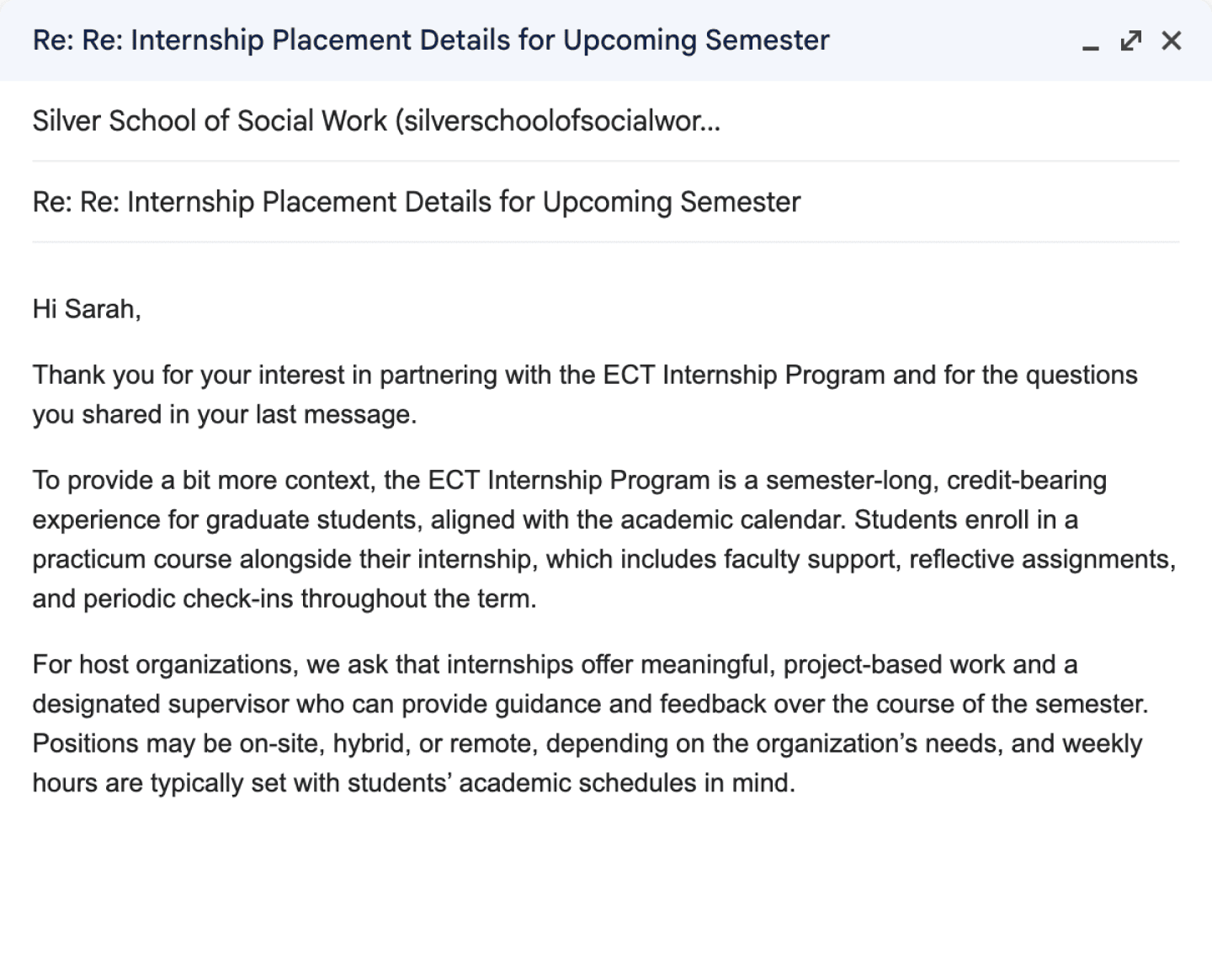
Generating positions through back-and-forth emails
Previously, partner organizations would email back and forth with the ECT Internships Program admin to learn about the program and post an internship application. This often resulted in incomplete, vague position postings.
Our Solution
Creating positions directly from a form
Step One
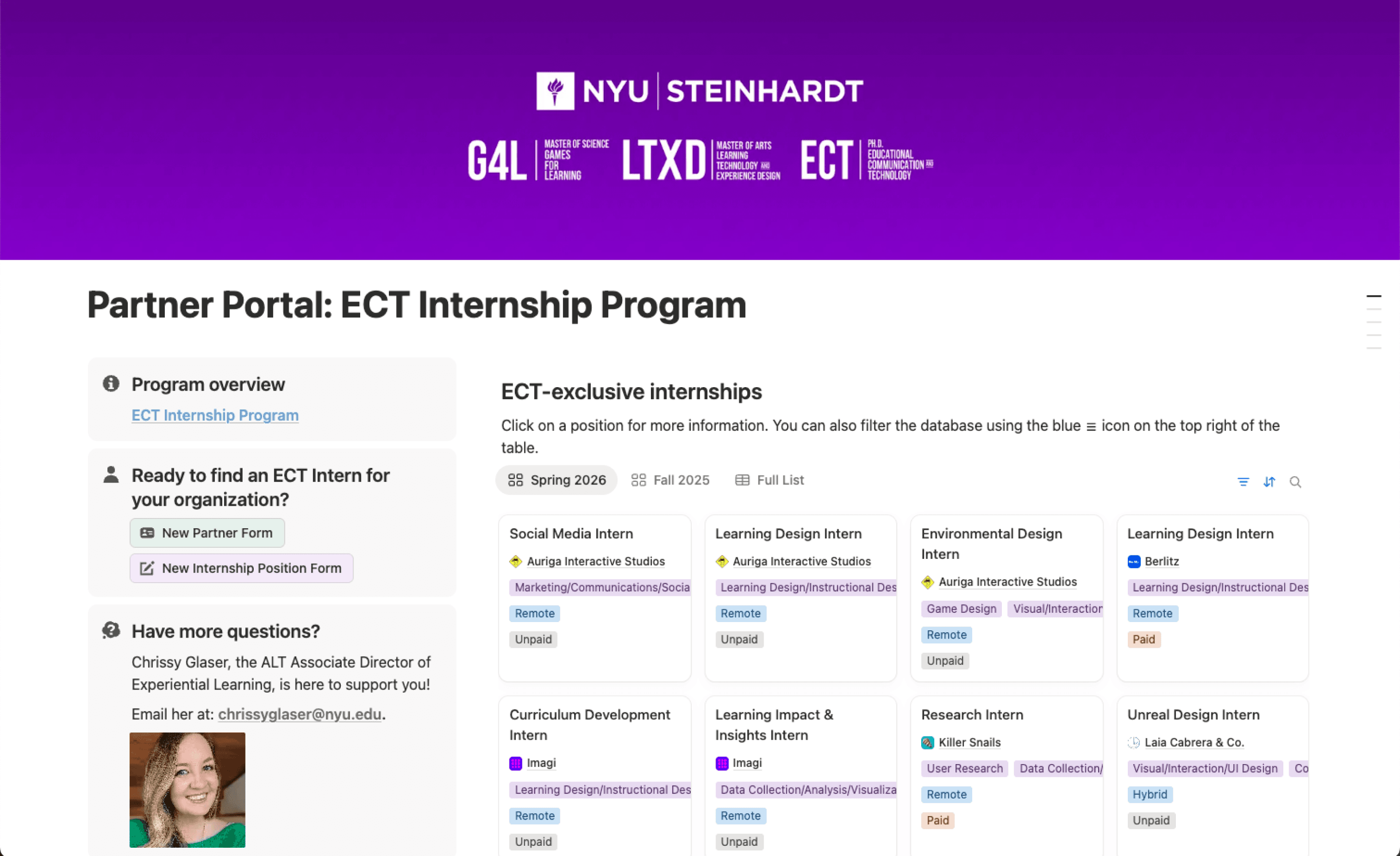
Accessing Information
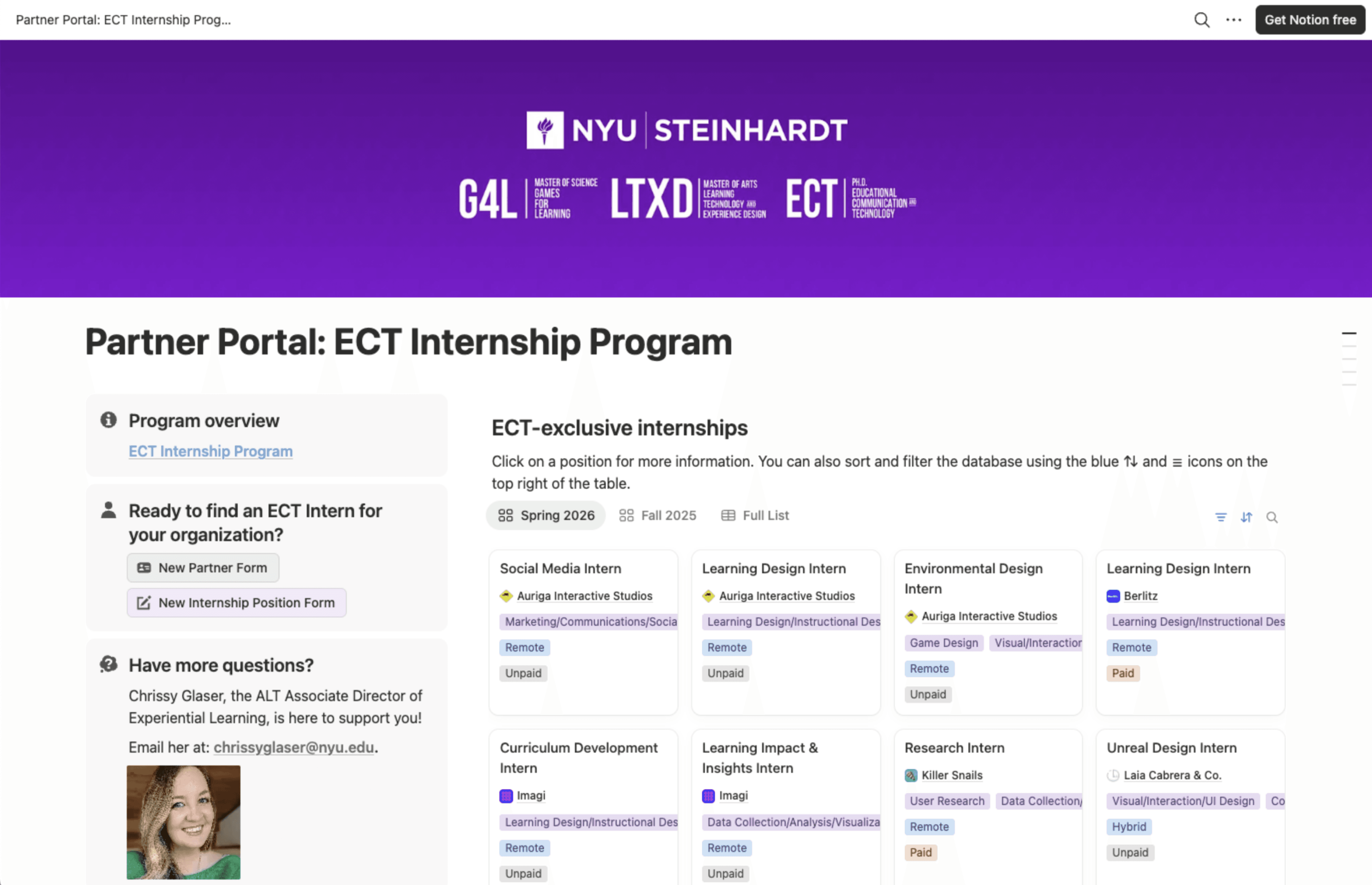
The comprehensive Partner Portal in Notion allows potential partners to learn about the program through a simple link.
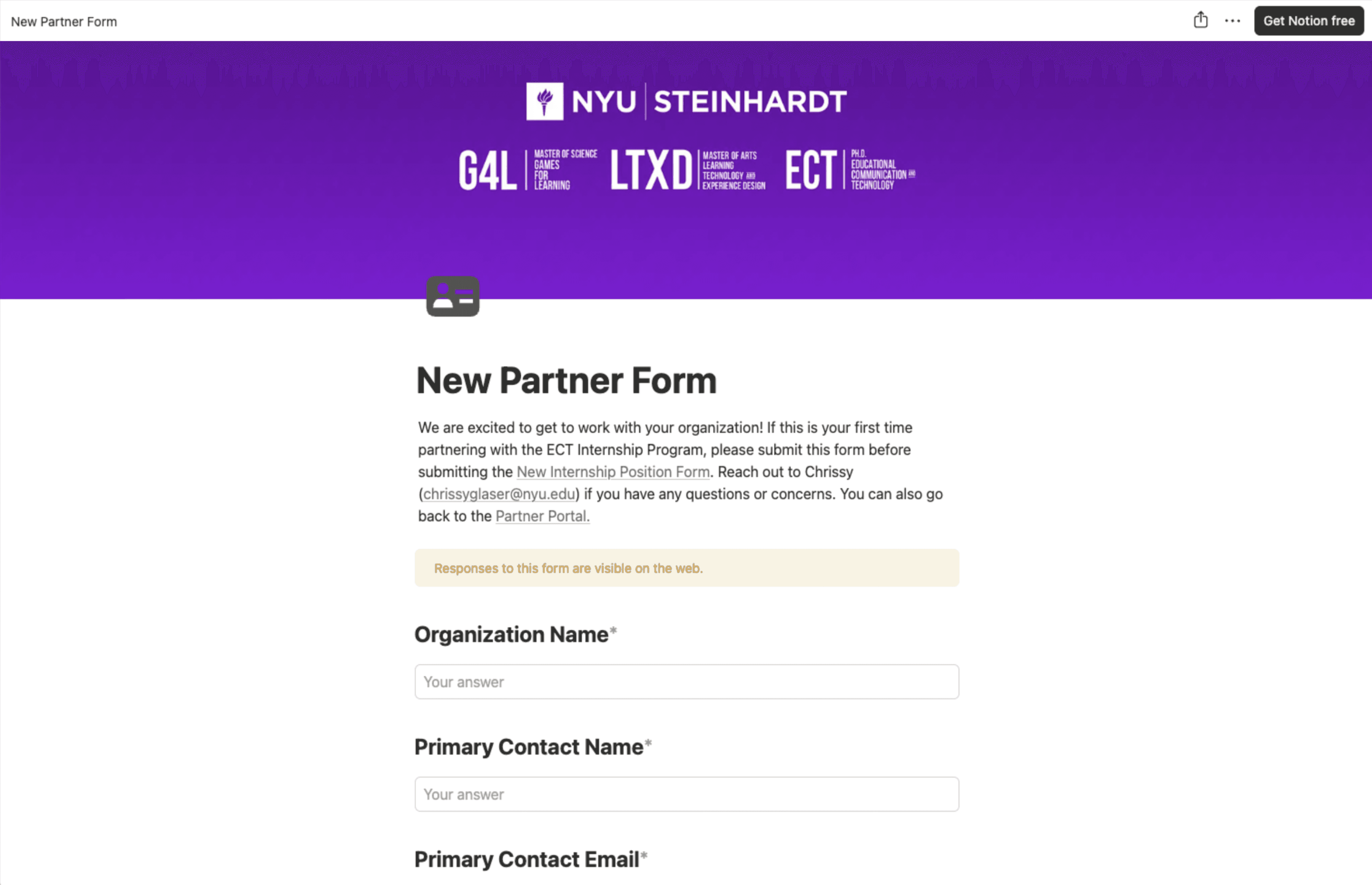
The New Partner Form collects necessary admin-side information about organizations, while the New Internship Position Form streamlines the position submission process.
Step Two
Generating the Position
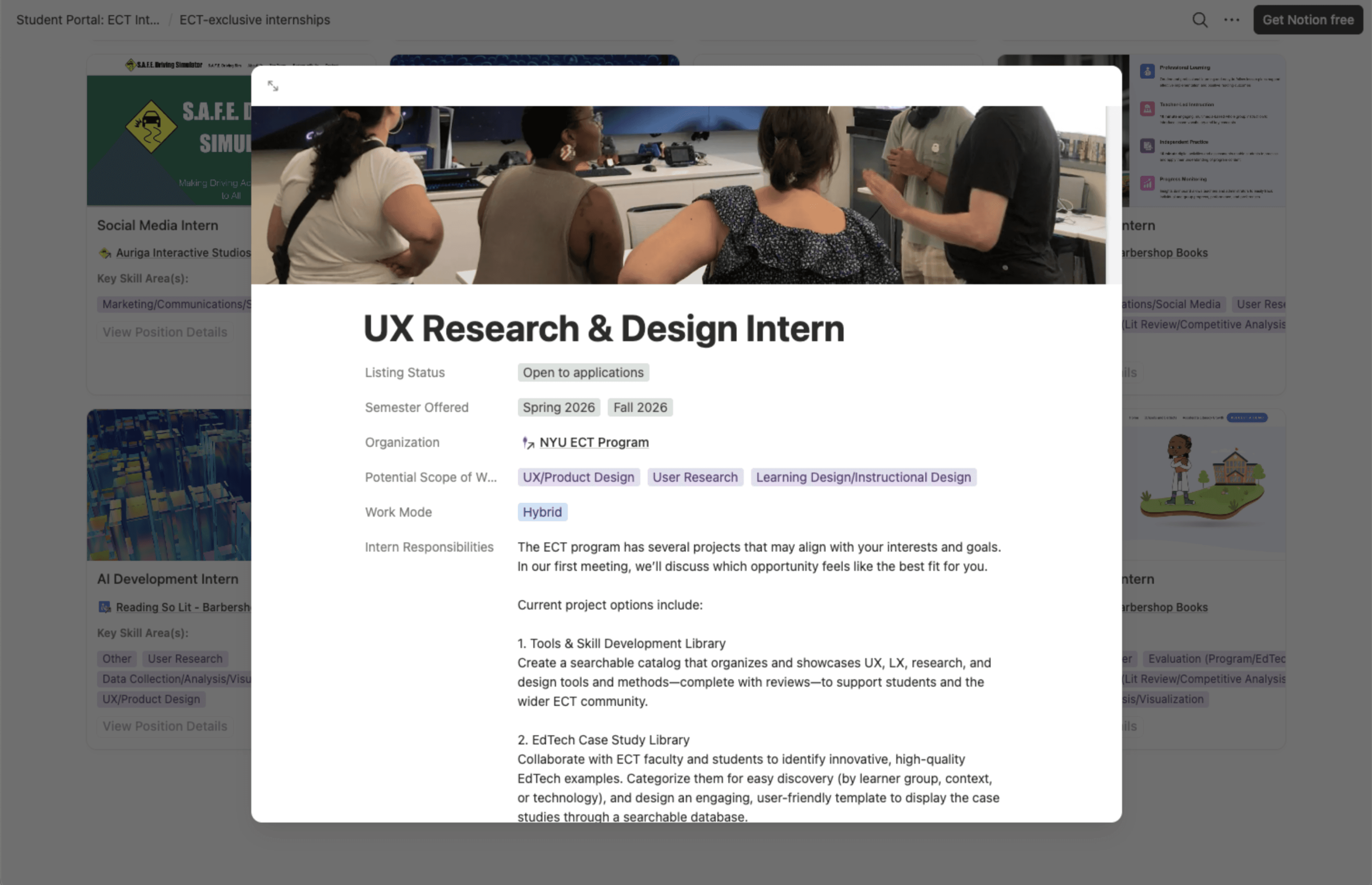
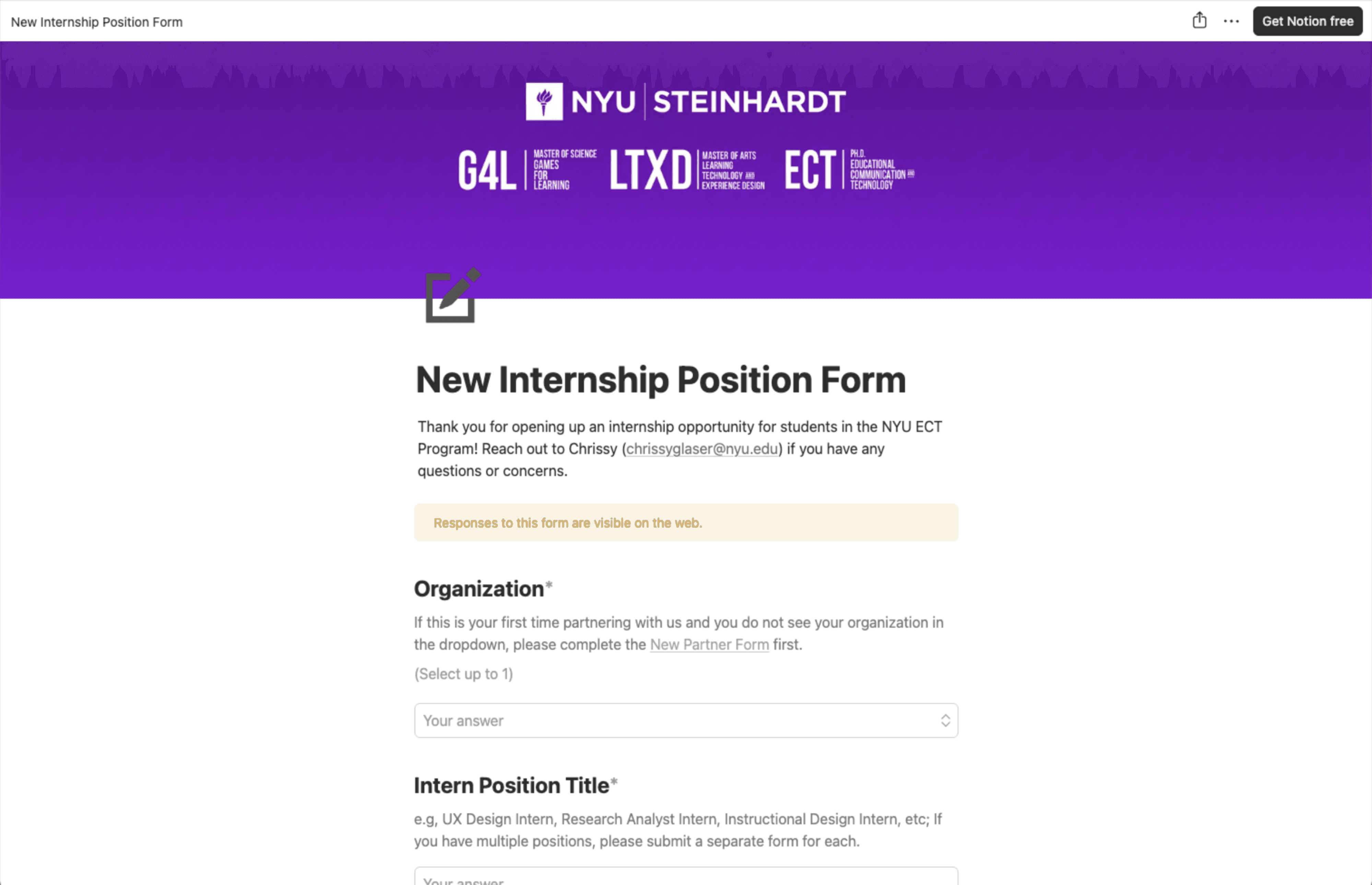
Partners complete the New Internship Position Form, which generates a new position posting within the admin-only database and notifies the administrator via Slack.
The admin can then review the position submission and make edits as needed.
Click play to scroll through the form. These fields directly populate the internship posting.
Click to watch the admin review process which copies a position to the student-facing database.
Step Three
Publishing to Students
When the position is ready to submit, the admin changes the status, which automates a new position in the student-facing database.
This second automation and separate database ensures that no sensitive, admin-only data is student-facing.
Why It Works
Our solution moves the workflow out of the admin’s email inbox and into a dedicated workstation where positions can be approved and posted in minutes, rather than days.
Key Features
Outlines key information about the program through the Partner Portal
Intakes new organizations through the New Partner Form
Automates position submissions with the New Internship Position Form
Removes sensitive, admin-only data from positions before publishing
Internship Position Database
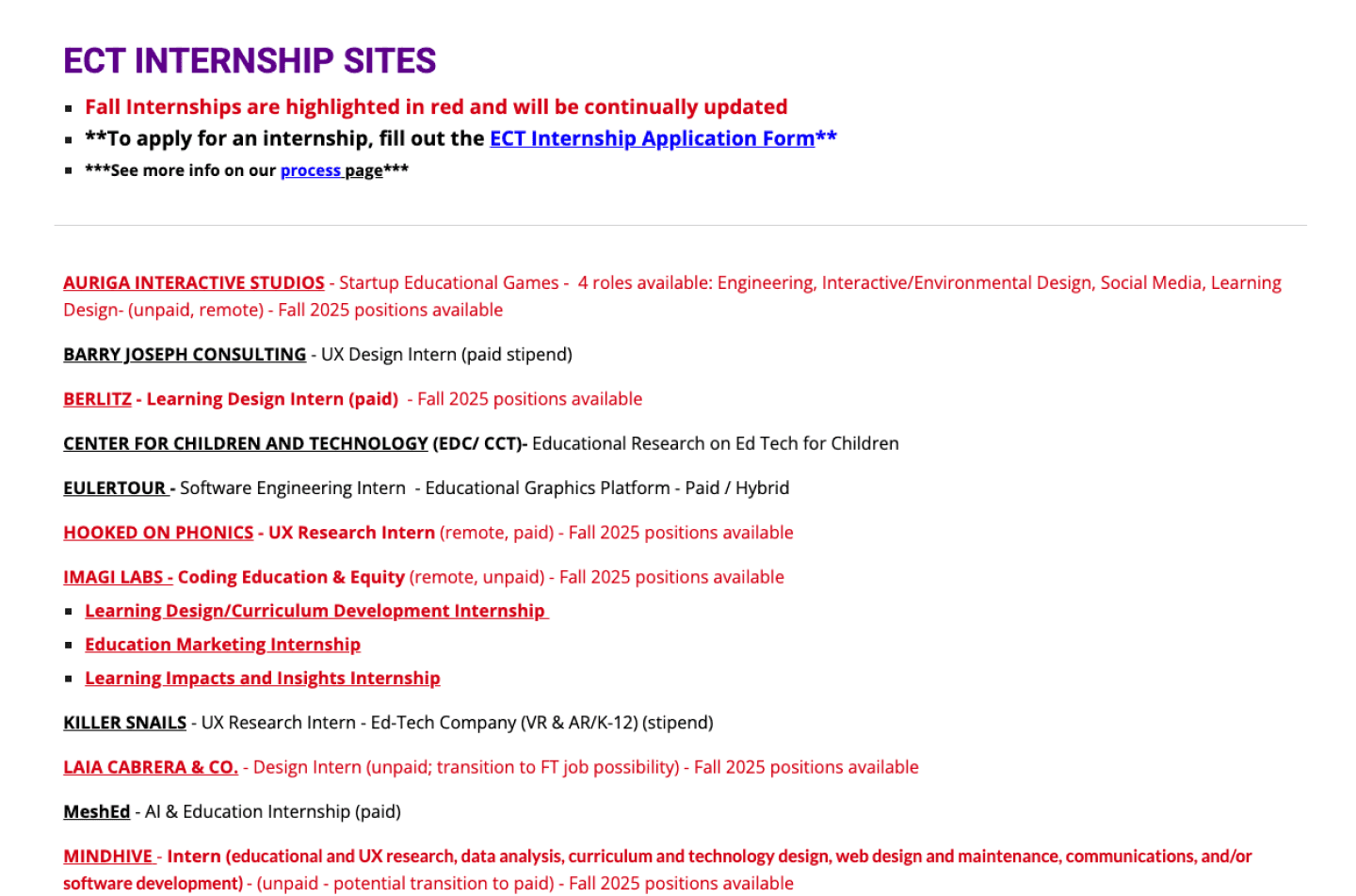
The Challenge
Google site requiring manual entry
The original position list, which required manual updates, had inconsistent formatting and content.
Our Solution
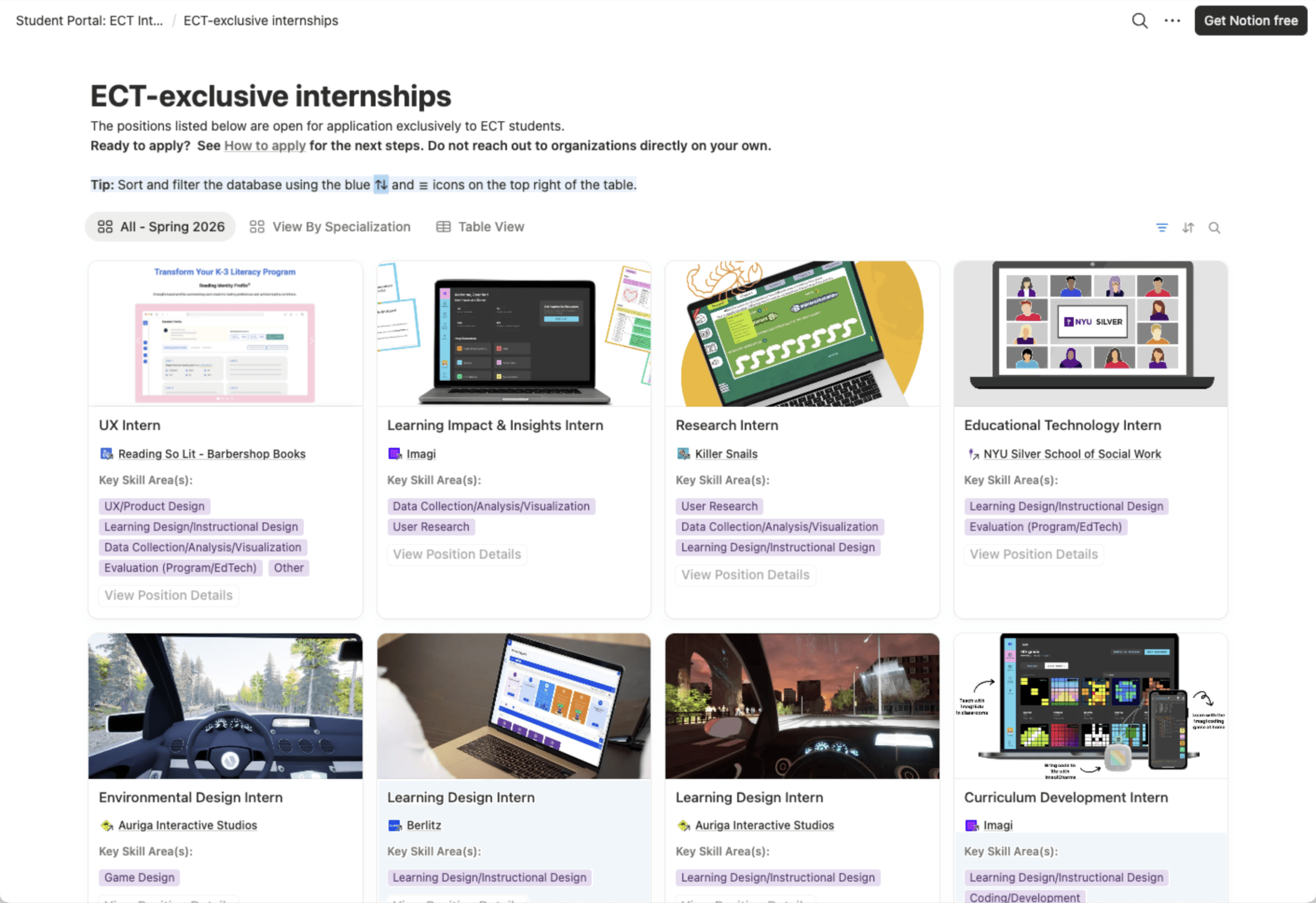
Automated Notion database
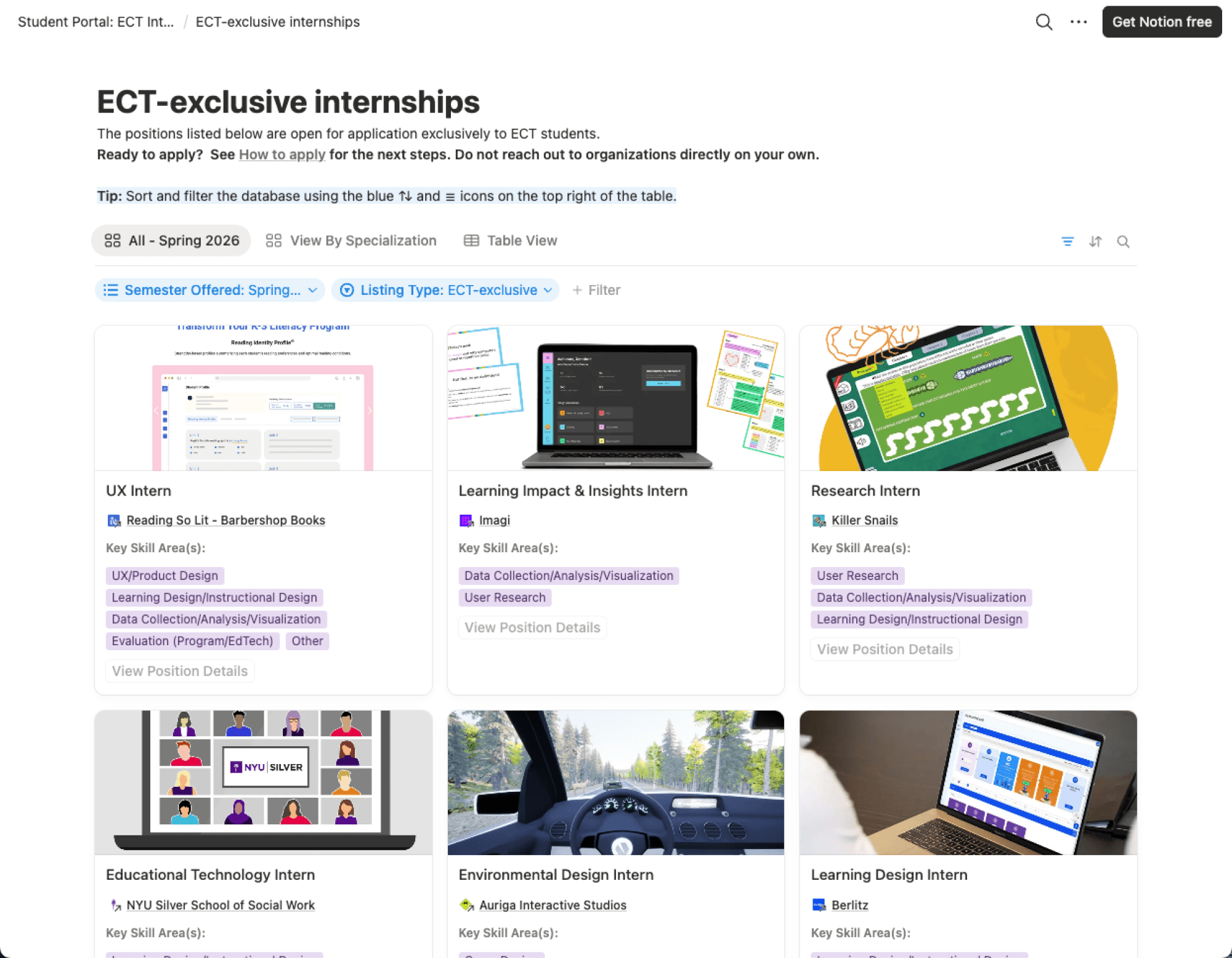
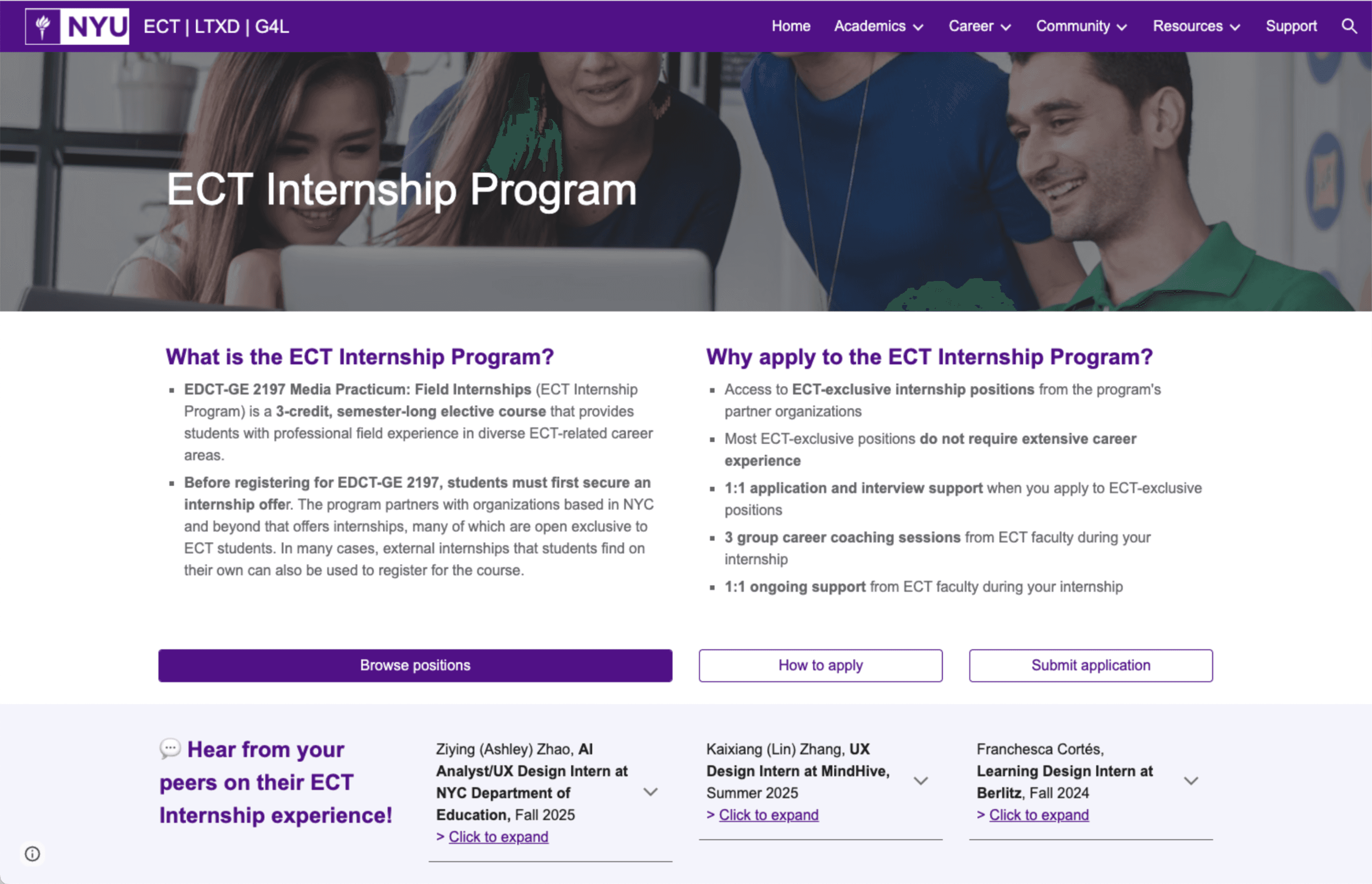
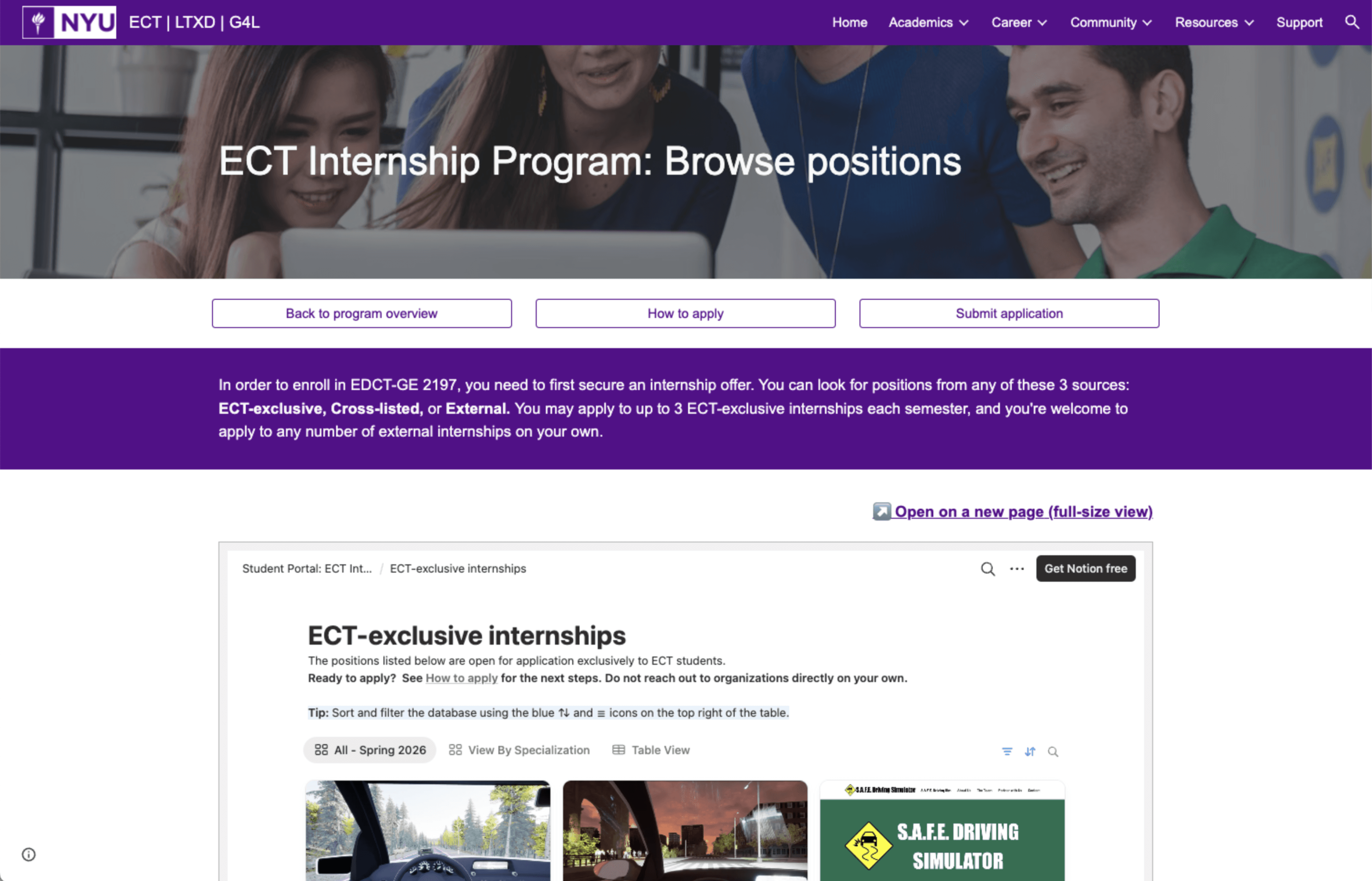
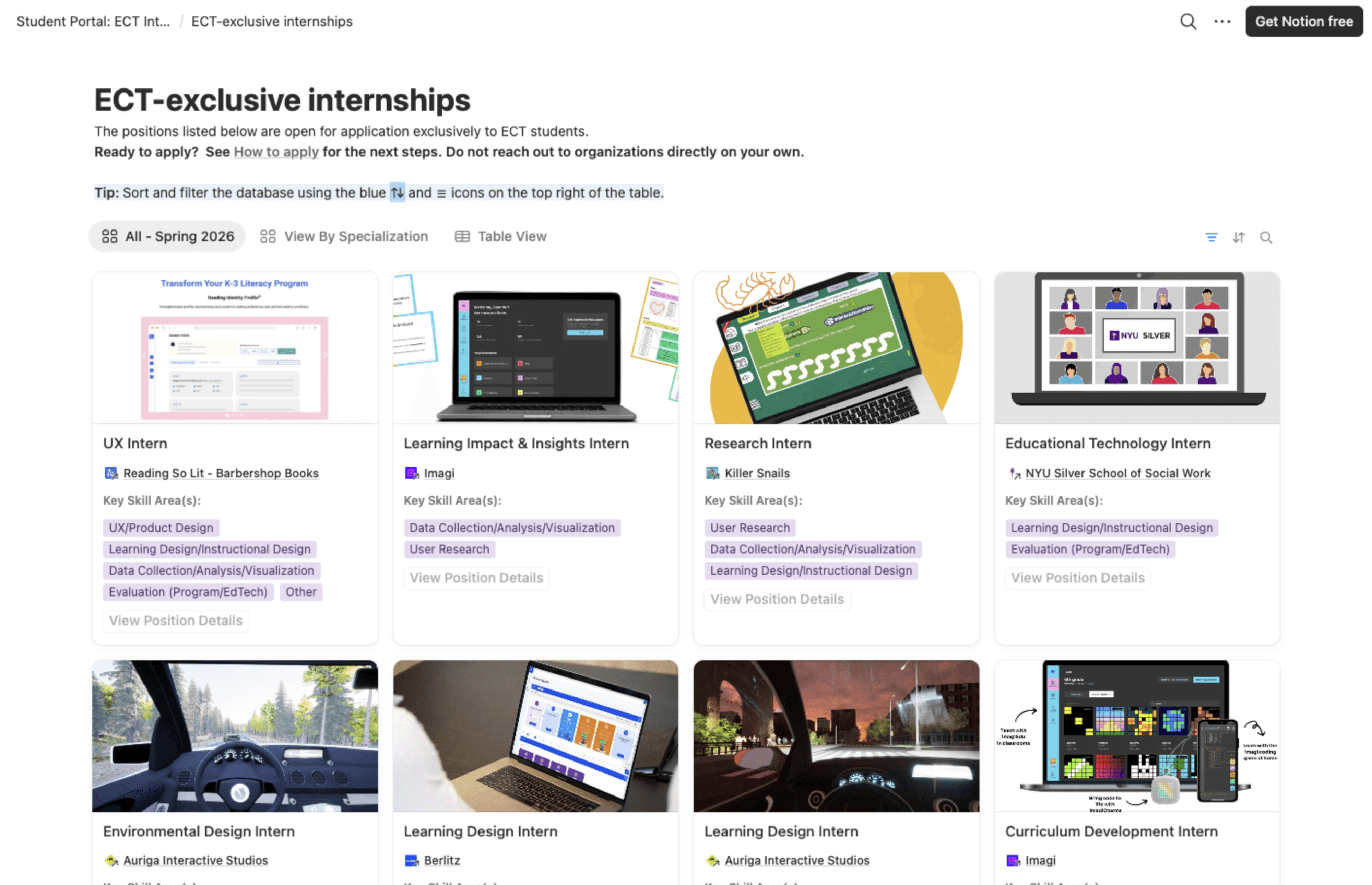
Our solution is a dynamic and standardized database of positions embedded directly into the ECTHub site that offers students multiple ways to find their perfect internship through search, filters, and career-interest-specific groupings.
Why It Works
Our research showed students scan visually and filter by specialization first, so we prioritized large cover images and grouped views over dense text descriptions.
Key Features
Templatized postings with standardized fields to solve inconsistency
Metadata tagging for filtering (specialization, compensation, etc.)
Automated posting creation from partner forms to save admin 10+ hours
Gallery view with cover photos to improve visual scanning
Specialization-focused view that groups positions by career area
Iteration in Action
Usability Testing Updates
After conducting think-aloud usability tests with 6 participants, we made key improvements to both the notion database and the program webpages.
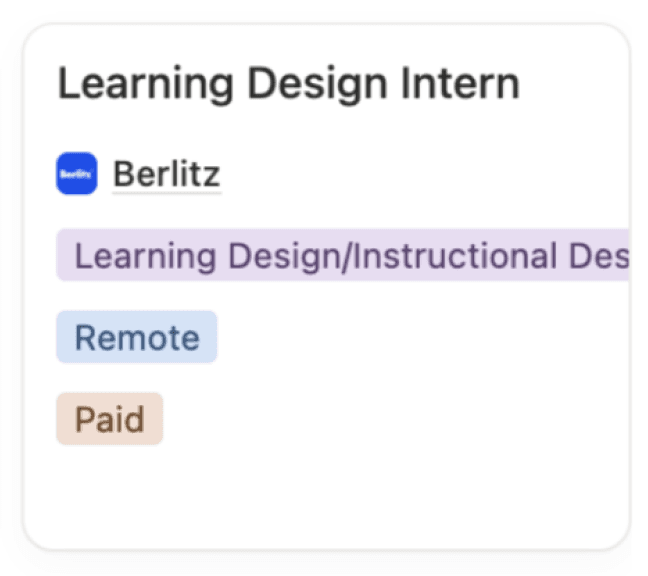
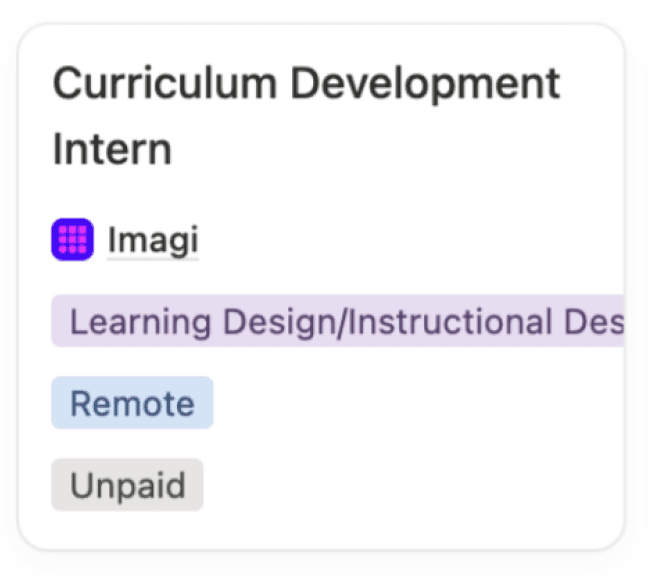
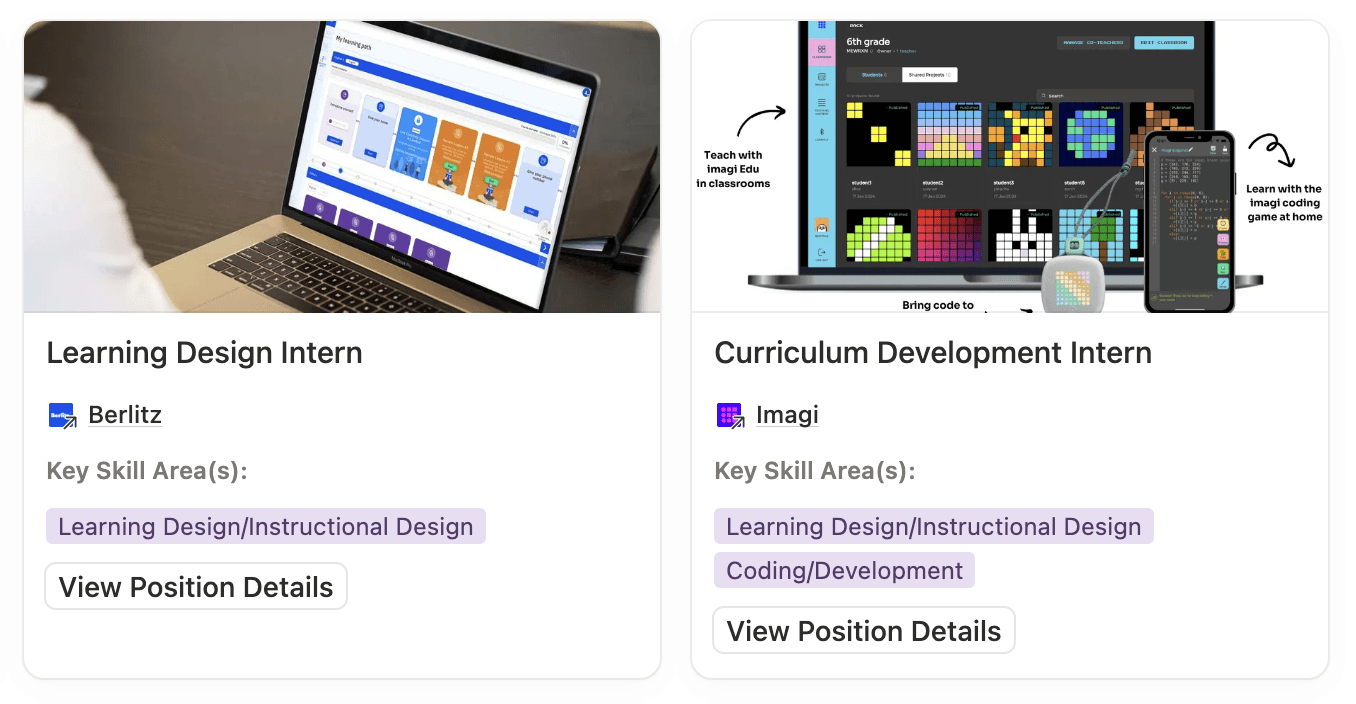
In addition to the gallery view, shown above, we also implemented a list view as well as a gallery view grouped by career interest, the most important criterion for students.
Informed by our research findings, we updated the website copy by adding:
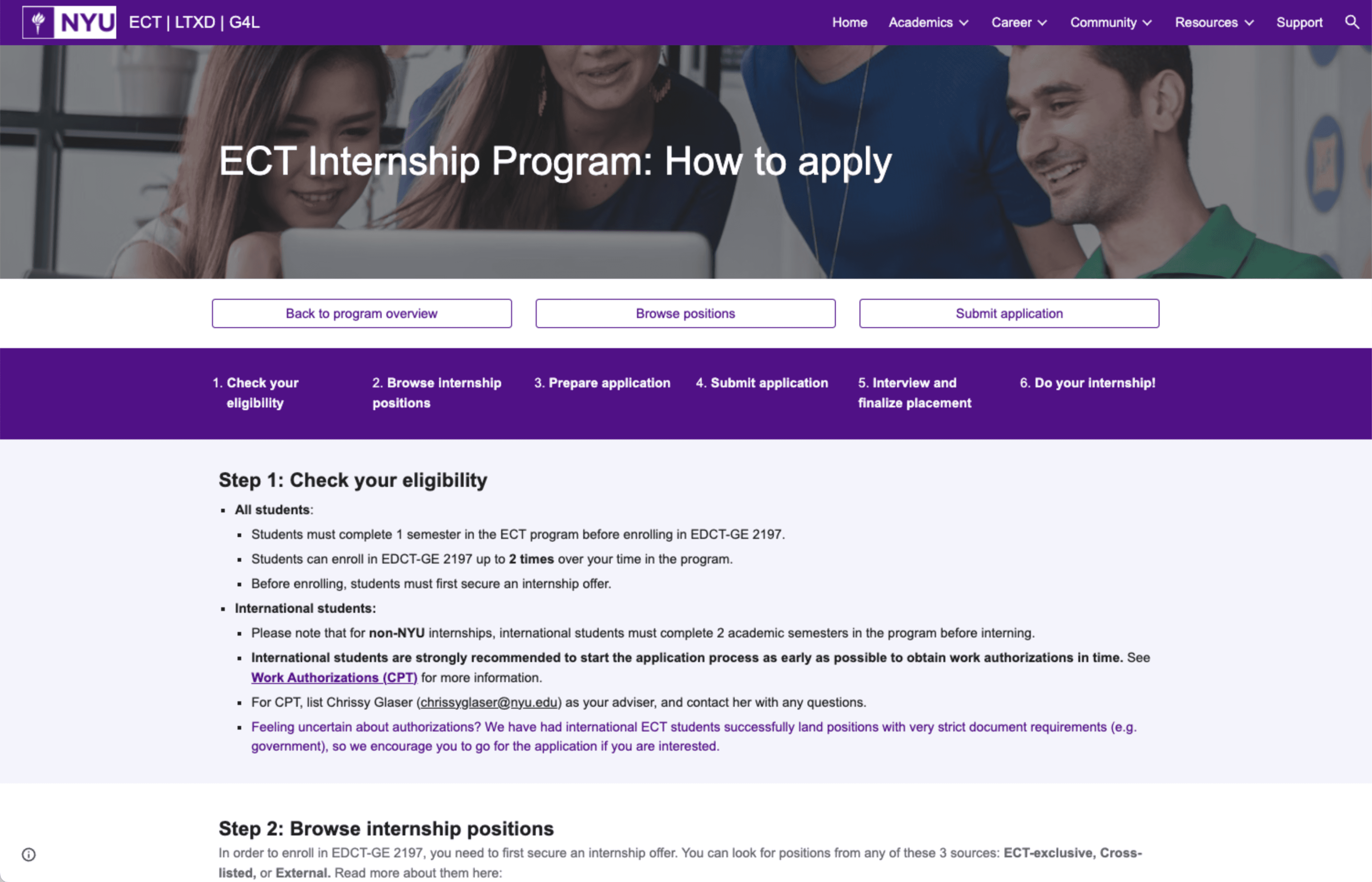
A marketing-focused landing page with a more detailed subpage outlining the application process
Easy-to-find navigation links at the top of the landing page
Updated student testimonials
Clear timelines with priority deadlines to encourage early applications

We worked in real-time and successfully launched our initial solution in just 7 weeks to hit the critical deadline of the ECTHub website launch.
Final Product
Our solution, viewable below, is live on the ECTHub site (linked here).
“I am beyond thrilled with how everything turned out and so impressed with what you accomplished in just a few weeks."
— Chrissy Glaser, ECT Internship Program Admin
7
Applications submitted
In the first 4 weeks of the Spring 2026 Internship application cycle, 7 students applied to the program, with many more expected during the NYU winter break.
2
New Partner Organziations
In the first 2 months of launching, the Partner Portal helped the ECT Internships Program foster relationships with 2 new partner organizations, with a few more anticipated before the spring semester.
100%
Usability Task Completion
All 6 participants completed key tasks in usability testing with the redesigned site and Notion database.
"The site is easy to navigate and provides all the resources I might need as I start my internship journey at ECT. I feel confident about going through the steps of the process and exploring the requirements for each of the positions."
— ECT student and hopeful Spring 2026 intern during a usability test
I loved being able to work on this project for my NYU ECT community, and I’m excited that the redesign will have lasting impact on students for years to come.
What Worked:
Weekly Sprint Momentum: Defining 1-2 concrete deliverables each week prevented scope creep and helped us stay on top of the many moving pieces of the project.
Grounding Design Decisions in Research: Our interviews with ECT students revealed key insights that shaped how we worked and gave us plenty of future work recommendations to improve the program beyond the website and internship position database.
What I’d Do Differently:
Incorporate Co-Design Practices: While Xinhui and I are ECT students, neither of us have completed an ECT internship. Looking back, I wish we invited ECT interns into our design process more, rather than just having them participate in interviews and usability tests.
Explore Email Automation: Our automated Notion database significantly reduces the email back-and-forth with partners, but students continue to email admin with individualized questions and concerns. Finding a way to automate the process of providing this information to students while escalating necessary requests would help reduce administrative workload and provide timely information to students.