
Streamlining Badminton Tournament Setup
As part of the 2025 Dubstech Protothon, my team and I created RallyUP, a mobile-first app helping badminton clubs to streamline tournament management. With RallyUP, organizers can create brackets in minutes, track real-time scores, manage players, and share and review historical data, enhancing efficiency and community engagement.
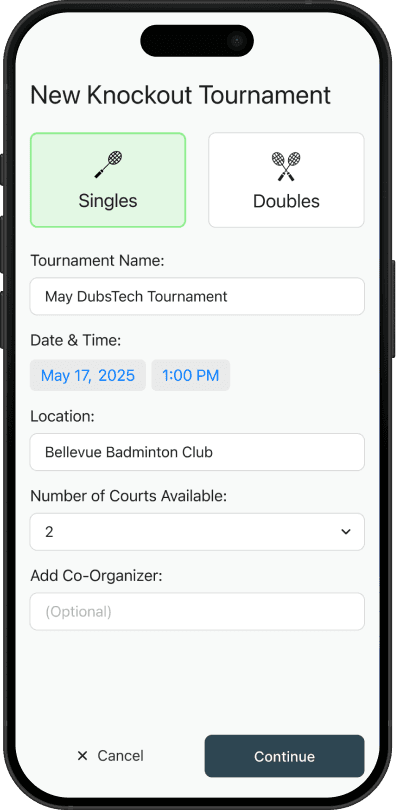
I led our user research, conducting a competitive analysis and guerrilla user observations through Reddit and other online platforms. I was also directly responsible for our Create a Tournament flow, which had over 20 screens.
Role: UX Research and Design
Tools: Figma, Discord, Figma Slides
Team: 3 designers
Timeline: 27 hours (May 10 – 11 2025)
Hackathon
UX Research
UX Design
Mobile
My team quickly ideated a solution with four key features: A mobile app that would allow badminton clubs to create and share tournaments easily, so all participants have access to relevant and timely info.
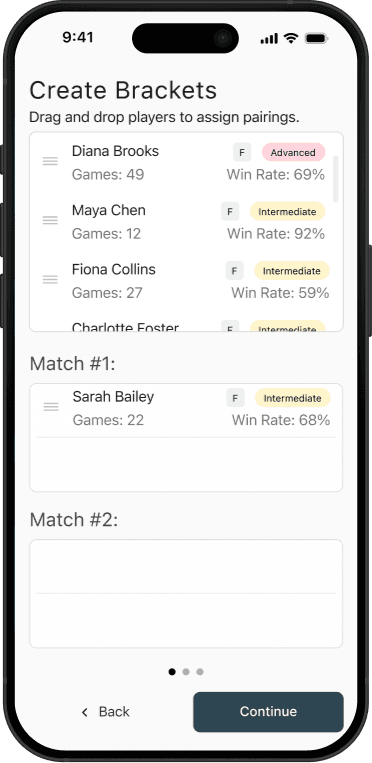
Match #1:
Charlotte Foster
F
Intermediate
Games: 22
Win Rate: 68%
Customizable Brackets
We wanted to reduce tournament setup time while maintaining the flexibility of manual spreadsheets.
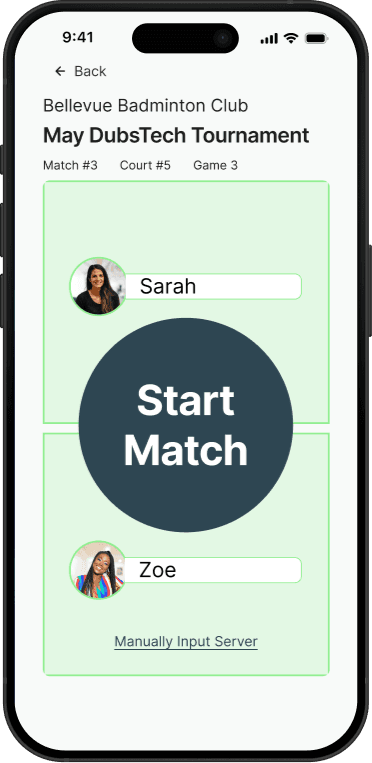
Easy Scoring
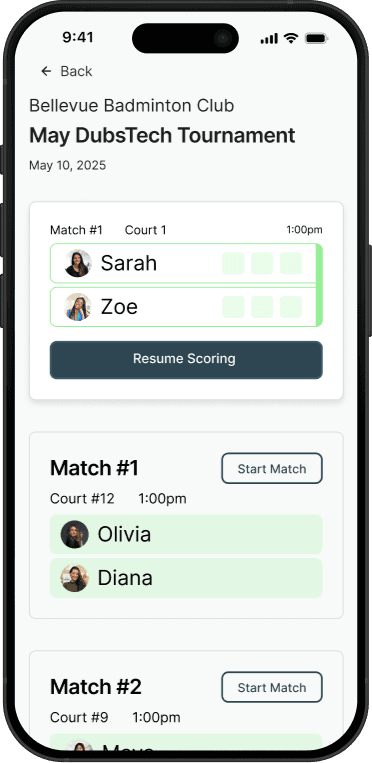
We envisioned an intuitive scoring system that would keep up with the fast pace of each match.
Championship
Court 1
Final

Fiona
21
20
23

Olivia
16
22
21
Sharable Results & Data
We also wanted players to view tournament results and share their individual stats in real time.
01
Evaluate existing solutions and understand the context and unique needs of badminton tournament organizers.
02
Help badminton club organizers create customized tournaments and one-off matches, maximizing flexibility for clubs of all sizes and players of all ability levels.
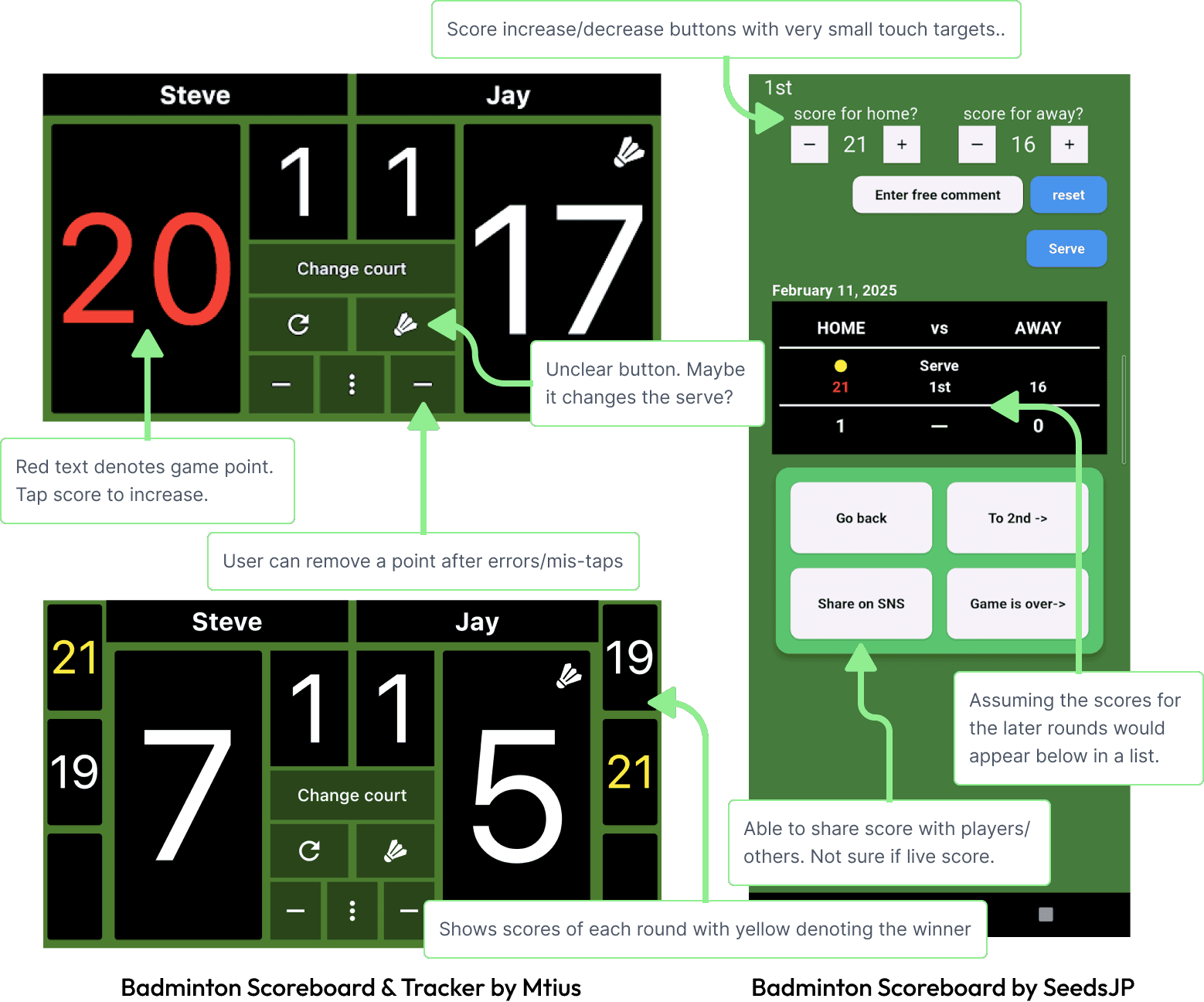
Even though we had a limited amount of time, I still prioritized user research to ensure that our solution was grounded in real user context. I conducted a competitive analysis of existing apps and explored badminton forums to see the pain points tournament organizers discussed most.
Competitive Analysis
Badminton Scoring Apps
Pros
Designed specifically for badminton scoring
Customizable names
Ability to takeaway points after mis-taps
Cons
Outdated UI
No instructions or helper text
Competitive Analysis
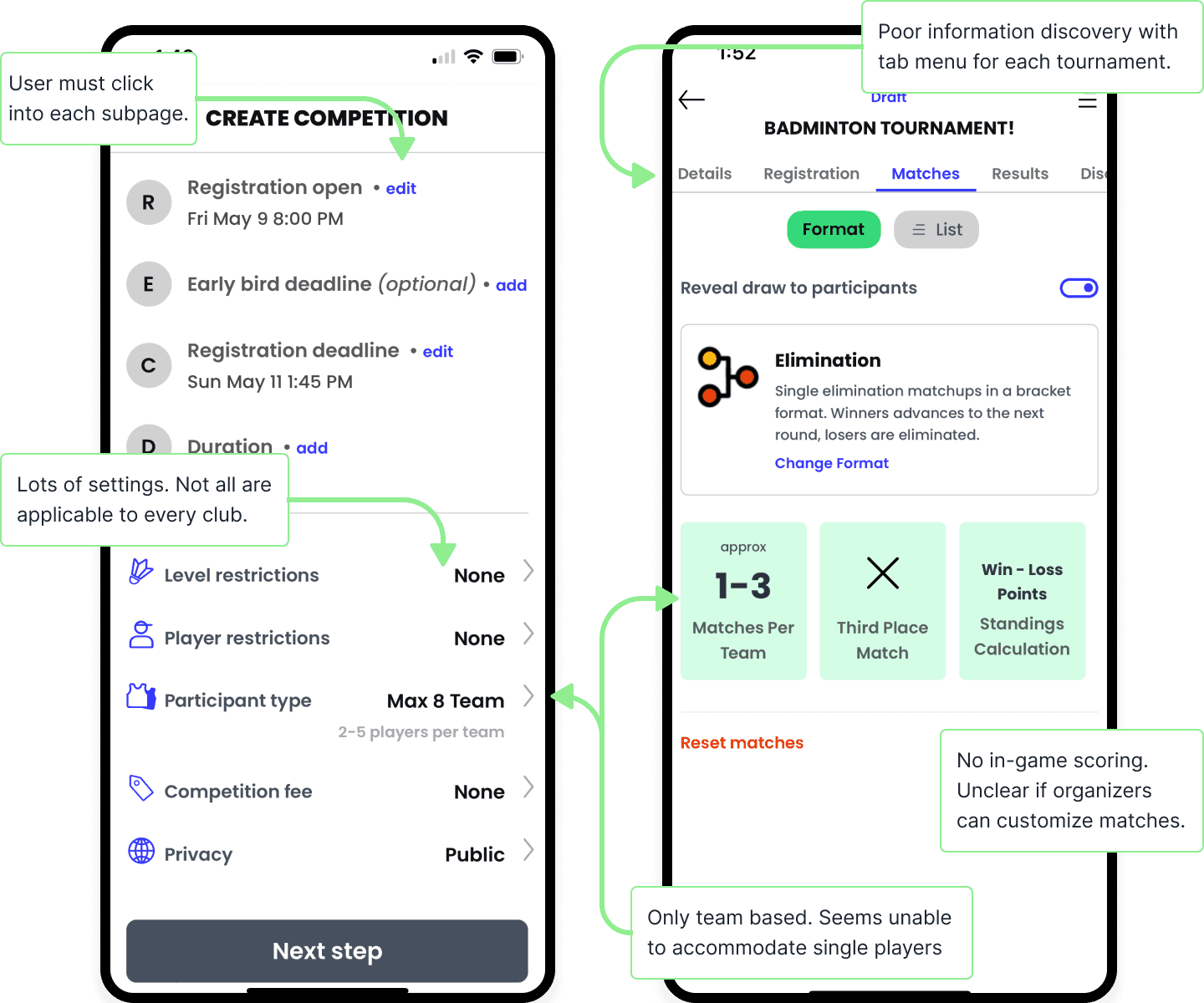
Reclub Tournament Creation
Pros
Allows for participant pre-registration and easy tournament setup
Multiple competition formats with customizable rules
Cons
Organizers cannot set up matches before participants register
Extensive set-up with lots of sub-pages with additional settings
No live scoring
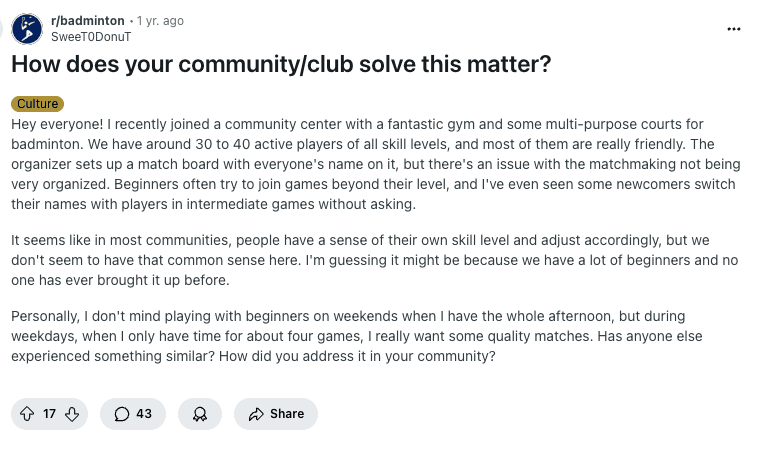
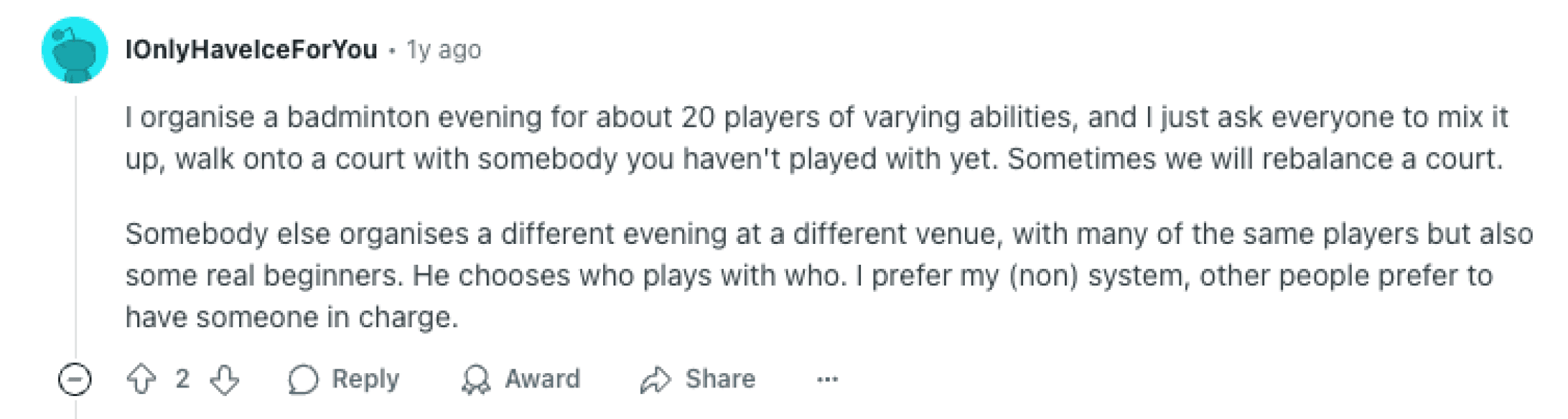
Conversation Mining
r/Badminton
Organizers were struggling to create matchups particularly when it came to beginners or groups with high variation in skill level.
No two organizers had the same technique, which meant that I had to maximize flexibility by providing random, seeded, and curated matchups.
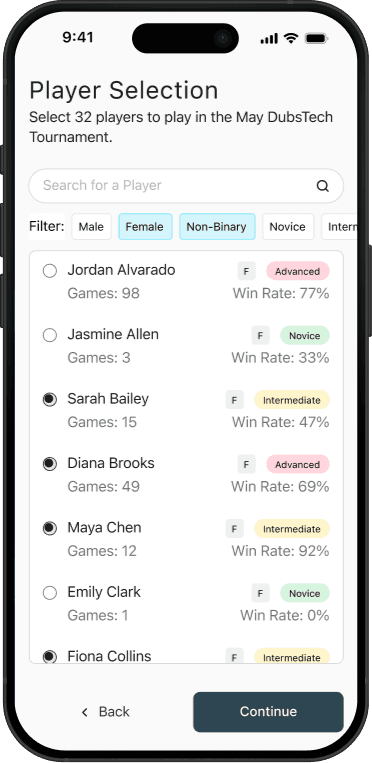
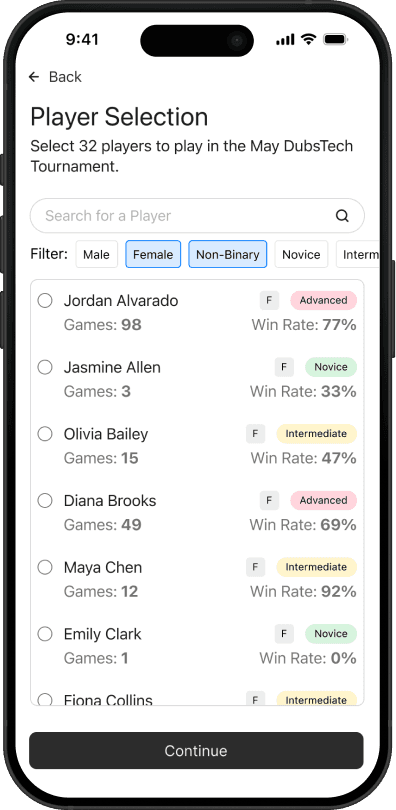
Based on my research, I maximized flexibility by creating two tournament types and three bracket options while still keeping each tournament flow to three main screens. I also designed a summary screen where organizers can review all settings before publishing the tournament.
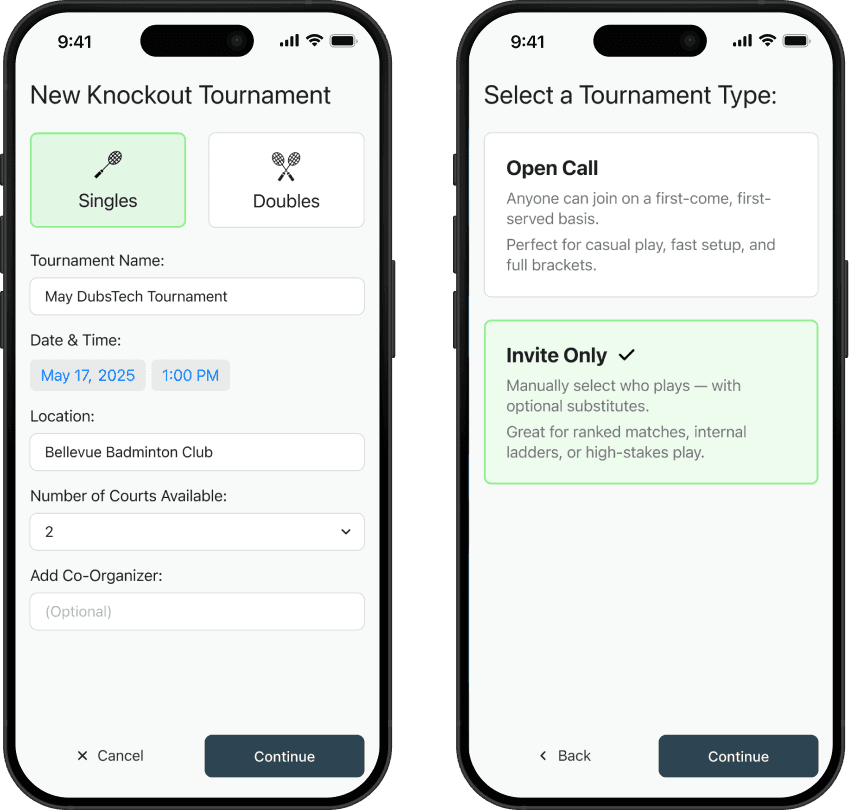
Flexible Tournaments
2 Types of Tournaments
Open-Call
Players join on a first-come-first-serve basis
Perfect for casual play and full brackets
Includes waitlist options and registration deadlines
Invite Only
Organizers select each participant manually
Optional substitutes can be added
Ideal for ranked competitions or skill-based events
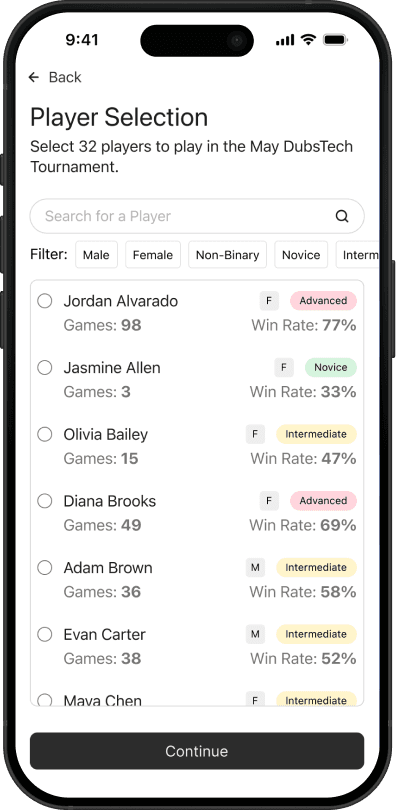
Customizable Brackets
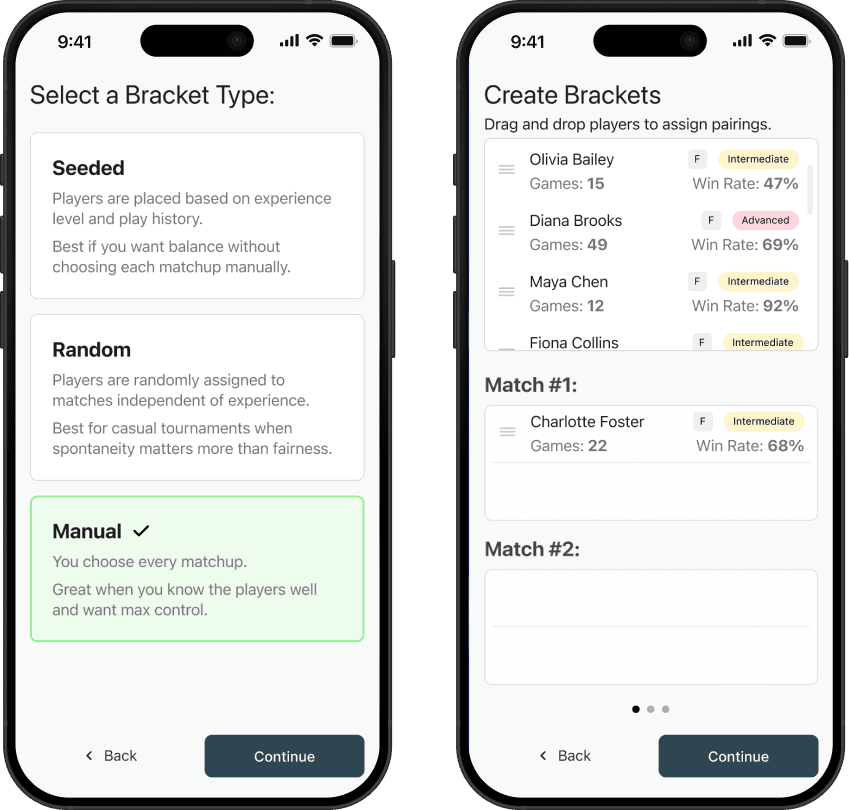
3 Ways to Create Brackets
Seeded Brackets
Uses system data (games played and win rate) to evenly distribute players
Best for fair and competitive play
Random Matchups
Matchups are assigned at random
Ideal for social nights and casual games
Manual Matching
Organizer decides each matchup
Great for those who know players skill levels and want full control
Easy drag and drop interface

One-Off Games
Friendly Matches
Players and organizers can score and track single game results without creating a tournament
Simply select match type, create pairings with easy drag and drop, and start playing in seconds
By offering maximum customization, RallyUP can be used by clubs of all sizes for all types of tournaments
Especially with large tournaments, my research showed that organizers may not want to manually pair people one-by-one, but random generators often create uneven matchups when the group has a large range of experiences.
Create a Tournament
Friendly Match
After a whirlwind of a day (& very little sleep), my team received a special mention for our work on RallyUP.
The judges were impressed by our strong user flow and feature planning in addition to our clear and effective final presentation.
Reflection
This was my first hackathon, and while I really enjoyed the experience, I did feel a bit out of my comfort zone designing screens rapidly with limited user context and no usability testing.
What Worked:
I built confidence in my rapid prototyping and Figma skills. I was able to create prototypes of three separate flows (two tournament types + friendly matches) with custom components in about 12 hours of work time.
Some research is better than none at all. Diving into club websites and Reddit threads helped me understand the problem better, which led to a finished product that was tailored to badminton club organizers’ unique needs.
What I’d Do Differently:
More Interaction Design. While it was not required of us, I would have liked to work on my prototype a bit more to help show my vision for what the final product would have looked like. If I had access to Figma Make at the time, I think that might have been a fun direction to sacrifice even more sleep to.
Design System Instead of UI Kit. My team agreed beforehand to use Apple’s Design Resources to keep our designs cohesive. However, I found it difficult to use Apple’s kit in my designs. Without customization, our screens looked generic, and I had to build several custom components. Choosing a design system before the hackathon started instead would have given us a stronger brand identity and more cohesion between our designs from the start.